
Do You Have to Dissociate for Ketamine to Work? What a New Brain Imaging Study Found
One of the most common questions people ask before a ketamine treatment is something along the lines of: Am I going to lose my mind? Is it scary to dissociate? Do I have to do that to feel the benefit? A brain imaging study published in Neuropsychopharmacology answers that last question directly. Ketamine's pain relief and ketamine's altered states ran on separate systems in the brain, and the volunteers who felt the most detached were not always or necessarily the ones who got the most relief.
What the Researchers Did
The study came from the Institute for Psychedelic Research at Tel Aviv University and the Sagol Brain Institute at Tel Aviv Sourasky Medical Center. 37 healthy volunteers, 21 of them women, each served as their own comparison. Every person came in for 2 separate sessions about 3.5 weeks apart: one with intravenous ketamine, one with a saline placebo. 33 completed both.
During each session, while lying in an MRI scanner:
Ketamine was given at a standard pain-treatment dose. A 0.4 mg/kg bolus over 10 minutes, then a continuous infusion of 0.4 mg/kg per hour.
Pain was delivered as calibrated heat to the right leg. The temperature was set individually for each person, so a rating of 8 out of 10 meant roughly the same thing for everyone. A much milder setting was used for comparison.
Dissociation was measured repeatedly with the Clinician-Administered Dissociative States Scale, a standard questionnaire about feeling detached from yourself or your surroundings.
The brain was analyzed 3 ways: region-by-region activity, a multivoxel pattern trained to predict pain, and the strength of the connections within and between brain networks.
Because each person received both ketamine and placebo, the researchers could ask a very specific question: within the same person, on the day they felt the most detached, did they also feel the most relief?
Ketamine Lowered Pain and Raised Dissociation, But Not Together
Both effects were large.
People felt less pain during the ketamine session. They rated the same intense heat as less painful than they did on the placebo day (session by pain intensity interaction, F(1,54) = 11.22, p = 0.001). The milder heat barely changed.
The same people felt much more detached during the ketamine session. Their scores for feeling disconnected from themselves and their surroundings rose sharply compared with the placebo day (main effect of session, F(1,32) = 57.44, p < 0.001).
The two did not move together. Across the behavioral and brain measures of pain and dissociation, correlations ranged from ρ = -0.24 to 0.32, and none of them reached significance (all p > 0.09).
In plain terms, knowing how detached a person felt told you nothing useful about how much their pain had dropped. As the study's lead author, Dr. Noam Goldway, put it: “Participants who experienced strong dissociation did not necessarily benefit from greater pain relief, and vice versa.”
What the Brain Scans Showed
Two different brain systems were doing the two different jobs.
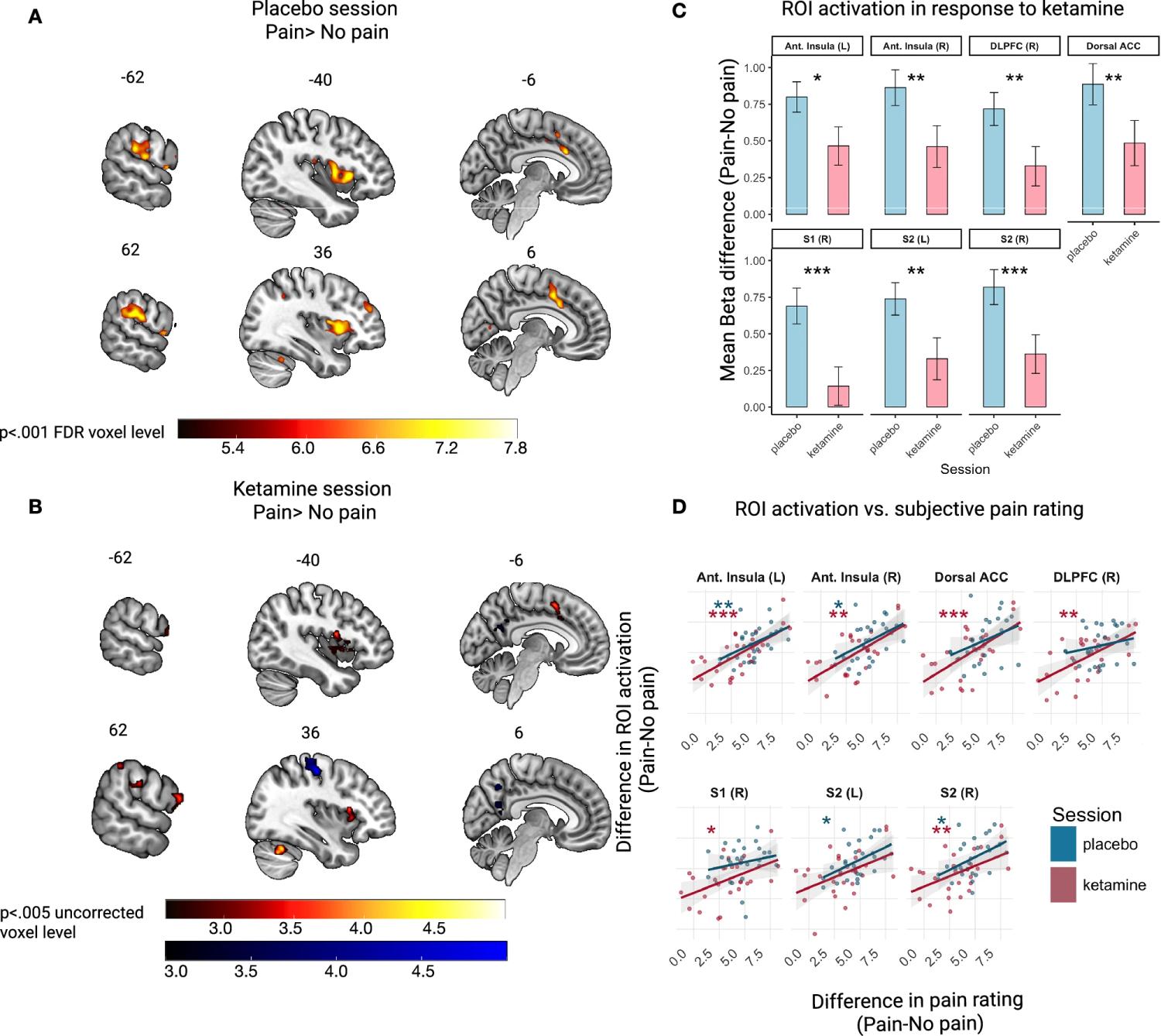
Figure 3 from the study. A shows the placebo session: painful heat lit up the usual pain-processing regions. B shows the ketamine session: the same heat produced much weaker responses. C breaks that down region by region, with placebo in blue and ketamine in pink. D shows that the link between brain response and the pain people actually reported held up in both sessions. Click the figure to open it full size on the journal's site. Image from Goldway et al., Neuropsychopharmacology (2026), used under CC BY 4.0.
Pain tracked with the pain-processing regions. The anterior insula, the dorsal anterior cingulate cortex, and the somatosensory cortex all responded less to the same painful heat on the ketamine day than on the placebo day. Pain levels also tracked with a multivoxel brain pattern trained to predict pain (ρ = 0.6, p < 0.001).
Dissociation tracked with something else entirely. The stronger a person's dissociation, the weaker the connections within their default mode network (ρ = .49, p < 0.01), the set of regions tied to self-referential thinking and the ordinary sense of being a self in a body. Dissociation did not track with the pain regions.
Panel D shows what that looked like person by person: in both sessions, the bigger someone's brain response to the heat, the more pain they reported. That link held on the ketamine day too, which suggests ketamine was turning down the pain signal itself rather than only changing how people described it.
In plain English: one set of brain regions registers pain. A different set maintains your ordinary sense of being yourself. Ketamine quieted the first set, which is why the heat hurt less. It loosened the second set, which is why people felt detached from themselves. The study found no link between how much each one changed. The strange feelings arrive alongside the pain relief rather than causing it.
Prof. Talma Hendler, who heads the Institute for Psychedelic Research at Tel Aviv University, summarized the point this way:
In recent years, there has been a lively scientific and clinical debate over whether the subjective experience produced by psychoactive drugs is an integral part of their therapeutic effect. Our study shows that, at least in the case of ketamine and pain relief, the answer is apparently no.
If the “Psychedelic” Part of Ketamine Worries You
Fear of the experience is one of the most common reasons people hesitate. Feeling detached from your body or your surroundings is strange.
The relief is not a reward for going deep. A session where you stay fairly clear, notice the room, and feel only mildly altered is not a session that underperformed. In this study, the people who barely dissociated got as much pain relief, on average, as the people who dissociated strongly.
It also means the experience is something your care team can shape rather than something you have to endure. Dose, pacing, the room, the music, and who sits with you can all be adjusted. What to Expect Before, During, and After Ketamine Treatment walks through what a session actually involves, and our published case series describes using low doses alongside pain reprocessing therapy, breathwork, and somatic work for chronic pain.
How This Can Guide Ketamine Treatment
Treat dissociation as a side effect to manage, not a target to hit. This study gives no reason to expect better pain outcomes from pushing a dose upward to produce a stronger experience.
Judge the treatment by what you came for. Pain levels, sleep, movement, mood, how much of the day the pain takes up, and side effects are what to track. The intensity of the experience is not a progress report.
Say so if the experience frightens you. A dose that feels overwhelming can often be lowered, slowed, or supported differently without giving up the pain relief. That conversation belongs in your treatment plan, not after the fact.
Comfort measures still earn their place. Music and preparation shape how a session feels, and how a session feels affects whether someone is willing to come back for the next one.
Expectation still has a role. What a person believes going in influences how treatment goes, which is one reason preparation is part of the protocol rather than an extra.
What This Study Cannot Tell Us
The participants were healthy volunteers, not pain patients. Controlled heat in a scanner is a useful model, and it is not the same as pain that has been present for years.
Everyone received placebo first and ketamine second. The authors list this as a limitation. Order and expectation could have shaped the results.
The numbers are small. 33 people completed both sessions, and dissociation was rated only a handful of times per session.
These are correlations measured during a single infusion. They show which brain systems move together, not what causes what, and they say nothing about relief that lasts for weeks.
This was about pain, not depression. A separate 2023 trial that gave ketamine to depressed surgical patients while they were under general anesthesia pointed in a similar direction, but the antidepressant question is still actively debated and is not settled by this study.
A calmer session is not a lesser session. If the fear of a frightening experience is what stands between you and trying ketamine, this study speaks to it directly. In a controlled, within-person comparison, the pain relief and the strange feelings came from different places in the brain, and more of one did not buy more of the other.