
What Is Driving Your Pain? A New Study Sorted 515 Adults Into 3 Pain Profiles
Two people can rate their pain a 7 out of 10 and be dealing with very different problems. For one, the pain sits in a single knee that was injured last month. For the other, it has spread, sleep is poor, bright light feels harsher, and worry about the pain has become part of the day. A pain score alone cannot tell those two people apart. A new study in PLOS One tests a way to do that with six short questionnaires.
The Seven "Pain Drivers"
The study builds on a framework published by Walton and Elliott that describes seven possible drivers of pain:
Nociception. Pain from tissue damage or inflammation.
Peripheral neuropathy. Pain coming from irritated or injured nerves.
Central nociplastic adaptation. A nervous system that has become more sensitive and amplifies pain signals.
Sensorimotor (dys)integration. A mismatch in how the brain senses and maps the body.
Cognitions and beliefs about pain. For example, catastrophizing, the tendency to expect the worst from pain.
Mood and emotions. Anxiety and low mood.
External socio-environmental influences. Things like discrimination, social stress, and financial stress.
Each driver points toward a different kind of treatment. The authors are clear that the evidence these drivers cause pain is still limited. The framework is meant to help clinicians recognize patterns.
What the Researchers Did
The team, led by David Walton at Western University in Ontario, combined data from two groups of Canadian adults (515 people in total):
332 military veterans with chronic pain, surveyed online. All had pain lasting at least 3 months.
193 injured workers in workplace compensation-funded physiotherapy in Ontario. Most (85%) joined within 90 days of their injury.
Everyone completed six brief self-report questionnaires covering central nociplastic symptoms, nerve-type symptoms, body awareness, pain catastrophizing, negative mood, and experiences of discrimination. There was no separate questionnaire for the nociception driver. When the other measures are low and the pain is confined to one area, the authors treat tissue-based pain as the most likely driver.
The researchers then used a statistical method called latent profile analysis, which looks for groups of people who share a similar pattern of scores. They checked the groups against pain intensity, how much of the body was painful (marked on a body map), and quality of life.
What They Found
An earlier study in the veterans alone had found 5 profiles. The injured workers matched only 4 of them. The profile driven by trauma and negative mood did not show up in the workers. The authors suggest this may reflect experiences more common in military service than in civilian work.
When both groups were analyzed together, 3 profiles held up:
Localized/Resilient (17.7%). Scores well below average on every measure, with less pain spread over less of the body.
Average (49.2%). Scores at or slightly below the middle of the group on every measure.
Complex, Central (33.1%). Scores above average on every measure, with the highest pain intensity and the most body regions affected.
Which group someone belonged to (veteran or injured worker) did not predict their profile. Sex, age, and education did not differ between the profiles either.
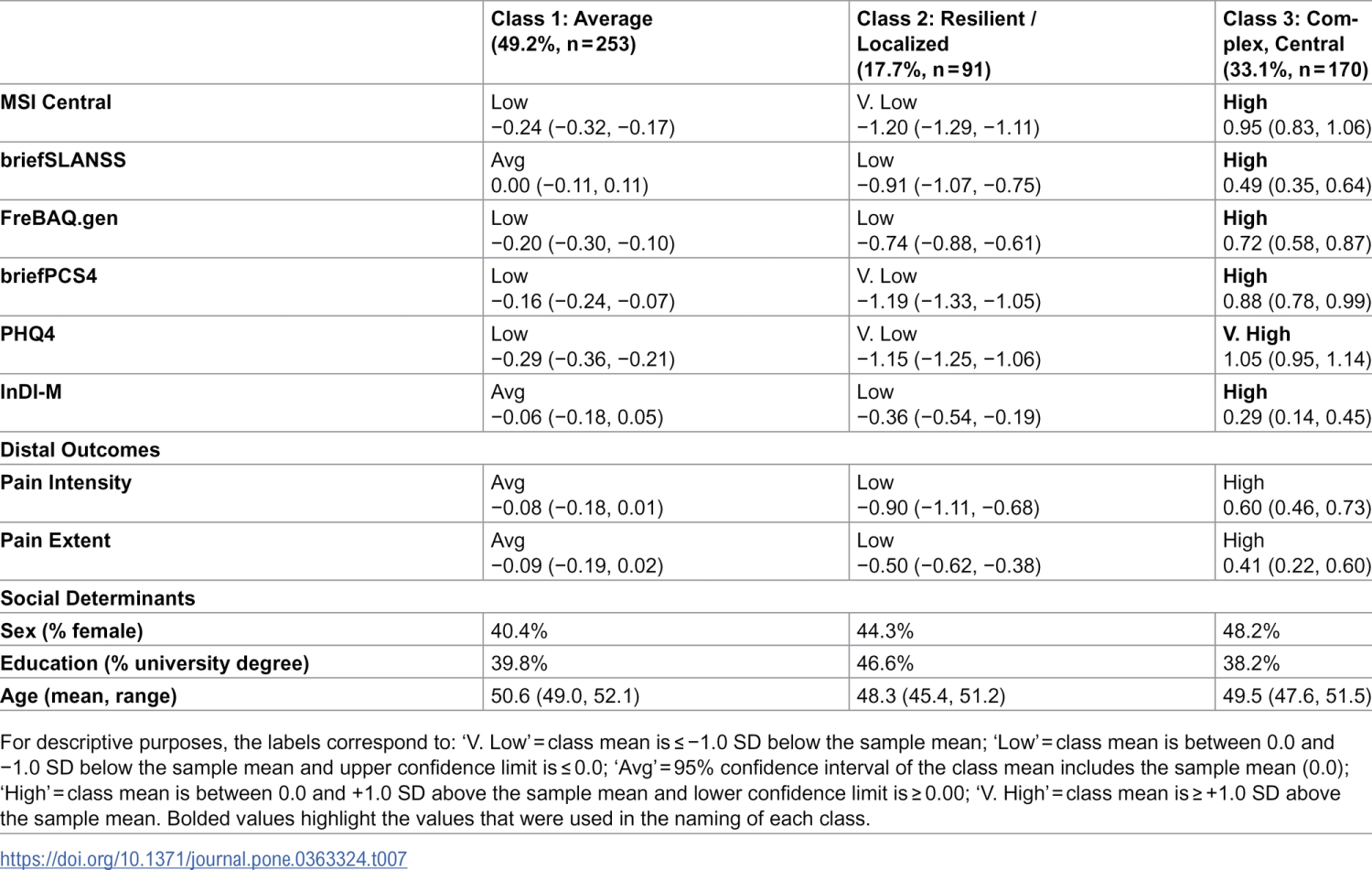
Table 7 from the study. Each column is one of the three profiles. The numbers are standardized scores, where 0 is the middle of the sample, negative numbers are below it, and positive numbers are above it. The Complex, Central group (right column) scored high on every questionnaire and reported more intense and more widespread pain. The Resilient/Localized group (middle column) scored low across the board. Table 7 from Walton et al., PLOS One 2026, CC BY 4.0.
Two measures did most of the work in sorting people: central nociplastic symptoms and negative mood. The central symptom questionnaire asks about symptoms beyond the pain itself, such as fatigue, nausea, and sensitivity to light. People in the Complex, Central profile scored highest on both.
The team also built a short scoring tool that placed people into the three profiles with 98.1% accuracy. The authors note that this number is very likely inflated, because the tool was tested on the same people it was built from.
What the Profiles Might Mean for Treatment
The profiles have not been tested as a guide to treatment yet. The authors offer a reasonable starting point:
Localized/Resilient may do well with conservative rehabilitation or very little intervention.
Complex, Central may be better suited to more intensive care that brings several disciplines together.
Average needs a closer clinical look to find out which drivers matter most for that person. In the injured workers, this middle group split into one subgroup with more negative mood and another with more sensorimotor symptoms.
In plain English, about one in three people in this study had a pain picture where a sensitized nervous system and mood were part of the problem, on top of whatever started the pain. That may call for a different plan than pain confined to one injured spot.
How This Fits With Our Approach
This study did not test any treatment, including the ones we offer. It does line up with how we think about pain at NeuroPain Health.
Our biopsychosocial model looks at the biological, psychological, and social sides of pain at the same time. For the biological side, that can mean interventional pain medicine, lifestyle medicine, and attention to a nervous system that has become oversensitized. For the psychological side, it can mean Pain Reprocessing Therapy, somatic tracking, and Mindfulness-Oriented Recovery Enhancement. Ketamine-assisted therapy is one more option, paired with preparation and integration. Our published case series describes combining low-dose ketamine with this kind of structured care for chronic pain.
The Complex, Central profile in this study looks a lot like the patients that approach is designed for. Whether matching treatment to profile improves outcomes is what the next study needs to test.
What This Study Cannot Tell Us
It is a snapshot. Everyone was measured once. We do not know whether people move between profiles over time, or whether the profiles predict who recovers.
Everything was self-reported. The questionnaires were short by design, which makes them practical but less precise. There was no physical exam or imaging in the analysis.
Both groups were Canadian convenience samples. Veterans who chose to take an online survey and injured workers from one clinic network in one province may not represent other people with pain, other countries, or people who never reach rehabilitation.
The scoring tool needs outside testing. Its accuracy has not been checked in a new group of patients.
"High" and "low" are relative. Scores were compared to the average of each study group, so a "high" score here is high compared with other people in pain.
The discrimination measure was dropped from the final model. It did not separate the groups well, especially in the injured workers. The authors stress this does not mean discrimination and social stress are unimportant for pain.
The paper also discloses that the lead author co-wrote a 2020 textbook that describes the seven axes.
The Takeaway
A pain score tells you how much it hurts. It does not tell you why. This study suggests a few short questions can begin to separate pain that is mostly local from pain where the nervous system and mood are heavily involved. About a third of the people studied fell into that second group. If your pain has spread, has outlasted the injury, or comes with fatigue, poor sleep, or low mood, it is worth asking your care team which drivers they are treating.
If you’re in South Florida and want a pain evaluation that looks at the whole picture, our team would love to meet you. Contact us.
This article is for educational purposes and is not medical advice. Talk with your physician before starting, stopping, or combining any pain treatment.
Reference
Walton DM, Bayattork M, Carter T, Cooper L, Bobos P, MacDermid JC. Latent profile analysis of a seven-axis pain drivers framework in adults with acute and chronic pain. PLOS One. 2026;21(11):e0363324. https://doi.org/10.1371/journal.pone.0363324