
Where’s your WOT Today? Understanding Your Window of Tolerance
Most of us have learned to judge our reactions before we’ve learned to understand them.
Why did I snap?
Why did I shut down?
Why does this feel harder than it “should” be?
The concept of the Window of Tolerance was originally introduced by psychiatrist Dr. Dan Siegel to describe the range of physiological and psychological arousal in which a person functions most effectively.
Within this range, individuals are generally able to think clearly, respond flexibly, regulate emotions, and engage with daily demands without becoming overwhelmed or shutting down. Outside of this range, functioning becomes increasingly difficult—not due to lack of effort or insight, but because the body–brain system has shifted into protective survival states.
The Window of Tolerance is a useful framework for understanding why reactions, energy levels, and emotional responses can vary so significantly depending on stress load and available internal resources.
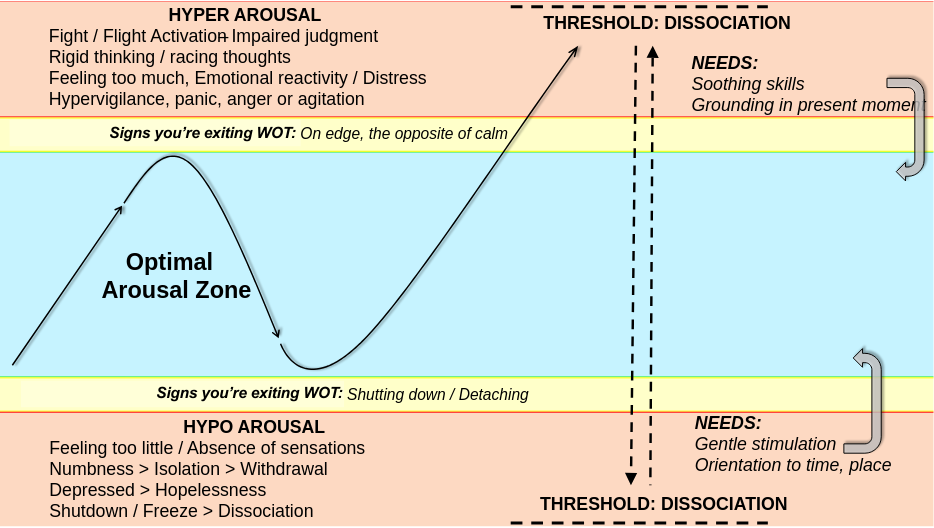
What exactly is the window of tolerance?
Think of your Window of Tolerance as the range where your body budget is balanced.
Inside this range:
You have enough energy to engage
Your thinking is clear enough to respond
Emotions move without overwhelming you
Your body feels steady rather than braced or collapsed
This is what people often call being “regulated,” but at its core, it simply means your body has what it needs (emotionally, mentally, and physically).
The Optimal Zone
When a person is within their Window of Tolerance—sometimes referred to as the optimal zone—there is sufficient balance between activation and recovery.
In this state:
Attention and concentration are available
Emotions can be experienced without becoming destabilizing
Communication is more effective
Stress can be met and resolved without lingering dysregulation
This does not imply the absence of stress. Rather, it reflects having enough physiological and emotional capacity to tolerate normal fluctuations in mood, energy, and challenge while remaining engaged and responsive.
States Outside the Window of Tolerance
When stress or perceived threat exceeds capacity, the system moves outside the optimal zone into one of two broad patterns: hyperarousal or hypoarousal. These are not pathological states; they are evolutionarily conserved survival responses.
Hyperarousal (Over-Activation)
In hyperarousal, the system is mobilized for action. Fight-or-flight mode is ON.
Common signs of this state include:
Heightened anxiety or agitation
Irritability or anger
Racing thoughts
Increased muscle tension
A sense of urgency or threat
Shallow breathing or restlessness
Feeling easily triggered
In this state, the body prioritizes protection over reflection. New information is harder to integrate, and reactions may feel disproportionate or automatic.
Hypoarousal (Under-Activation)
In hypoarousal, the system conserves energy. Freeze mode is ON.
This may present as:
Low energy or fatigue
Emotional numbing
Difficulty concentrating or initiating action
Withdrawal or disconnection
Dissociative experiences
Here, engagement is reduced as your body’s systems attempt to limit further demand.
Dissociation and Thresholds of Capacity
When arousal moves far beyond a person’s tolerable range (either high or low), dissociation may occur. Dissociation refers to a disruption in the integration of awareness, sensation, emotion, memory, or identity.
Mild dissociative experiences (such as zoning out or daydreaming) are common and often benign. More severe dissociation typically arises in response to overwhelming stress or trauma and serves as a protective mechanism when other forms of regulation are insufficient.
Importantly, dissociation is not a failure of awareness or effort; it reflects the system exceeding its current threshold for processing experience.
Factors That Influence the Size of the Window
The width of an individual’s Window of Tolerance is not arbitrary.
Baseline capacity is shaped by:
Genetics and early brain development
Early attachment experiences
Exposure to adversity or chronic stress
Significant stress, especially when experienced early in life, can sensitize the system and narrow the window, making it easier to move into states of overwhelm or shutdown.
At the same time, capacity is not fixed. With appropriate support, skills, and environmental conditions, the Window of Tolerance can expand over time.
Expanding Capacity Over Time
While individuals do not choose the size of the Window of Tolerance they begin with, capacity can be strengthened.
Expansion typically involves:
Increased awareness of early signs of over- or under-activation
Containers that support the reflection that enables this increased awareness (journaling, speaking to a coach or therapist)
Developing skills to modulate arousal (both up and down)
Supporting foundational factors such as sleep, nutrition, movement, and rest
Accessing safe relational support
Engaging in therapy when appropriate
The goal is not to eliminate stressors, but to improve the system’s ability to return to balance following the presence of stressors.
Why the Window of Tolerance Matters in Real Life
The value of the Window of Tolerance is not conceptual—it’s practical. This framework becomes most useful when applied to how we interpret our own behavior, relate to others, and make decisions under stress.
1. Reduced Self-Judgment Through Context
Understanding your own Window of Tolerance often leads to a meaningful reduction in self-criticism.
When capacity fluctuates, performance and emotional regulation fluctuate with it. This is especially relevant for women, whose physiological capacity may vary across the menstrual cycle due to hormonal shifts that influence energy, pain sensitivity, sleep quality, and stress tolerance.
Through the lens of the Window of Tolerance, these variations are not signs of inconsistency or weakness—they reflect predictable changes in capacity. Recognizing this allows for more realistic expectations, better pacing, and fewer internal narratives about “failing” or “regressing.”
In practice, this can mean adjusting workload, communication demands, or emotional expectations rather than pushing through at a cost.
2. Taking Others’ Behavior Less Personally
The Window of Tolerance also offers a useful relational reframe.
When someone reacts sharply, withdraws, or appears emotionally unavailable, it is often a sign that they are operating outside their own capacity at that moment. Understanding this does not excuse harmful behavior, but it does provide context.
This perspective can:
Reduce unnecessary personalization
Decrease escalation during conflict
Support clearer boundary-setting
Encourage better timing for difficult conversations
Rather than interpreting behavior solely as intent, the framework invites consideration of capacity.
3. Improved Timing and Decision-Making
Many decisions are made while individuals are outside their Window of Tolerance—during periods of overwhelm, urgency, or shutdown. In these states, access to nuance, long-term thinking, and integration is reduced.
Recognizing when you are outside your window allows you to delay decisions, conversations, or commitments until capacity is restored. This can significantly improve outcomes in professional, relational, and therapeutic contexts.
In short, clarity tends to follow regulation (not precede it).
4. More Effective Communication and Boundaries
Understanding the Window of Tolerance can improve how and when communication happens.
When people are outside their optimal range, feedback may be misinterpreted, intentions distorted, and conversations derailed. Awareness of this dynamic supports:
Choosing appropriate moments for discussion
Simplifying communication when capacity is limited
Recognizing when boundaries are needed rather than explanations
This is particularly relevant in caregiving, leadership, parenting, and therapeutic roles.
5. A More Accurate Lens for Stress and Burnout
The Window of Tolerance offers a useful way to understand cumulative stress.
Burnout rarely results from a single event. It often reflects prolonged periods of operating at or beyond capacity without sufficient recovery. The framework makes visible how repeated overextension gradually narrows the window, making previously manageable demands feel intolerable.
Recognizing this early allows for intervention before more entrenched patterns of dysregulation or shutdown emerge.