
Name It to Tame It: How Putting Anxiety Into Words Calms the Brain's Fear Response (a Study)
Trying to ignore anxiety (or fear, or any fear-based emotion) rarely makes it leave. It tends to sit just under the surface, shaping how you think, react, and feel in your body, often without your awareness.
What many people don’t know is that there is a simple tool that can be used to alleviate the fear/anxiety: name it. That’s not the same as perseverating on it, though (more on that toward the bottom).
A 2000 fMRI study from UCLA's Brain Mapping Division (Hariri, Bookheimer, and Mazziotta) gave us one of the clearest neurological pictures of why this works.
The Study: Hariri, Bookheimer, and Mazziotta (2000): Modulating Emotional Responses, Effects of a Neocortical Network on the Limbic System
Participants were placed in a functional MRI scanner and shown images of faces expressing fear or anger. They completed two tasks. In one, they visually matched the emotional expression on a target face to one of two faces below it, with no language involved. In the other, they identified the emotion on a target face by choosing the correct word, "angry" or "afraid."
The faces were the same threatening images in both conditions. The only variable was whether language was applied.
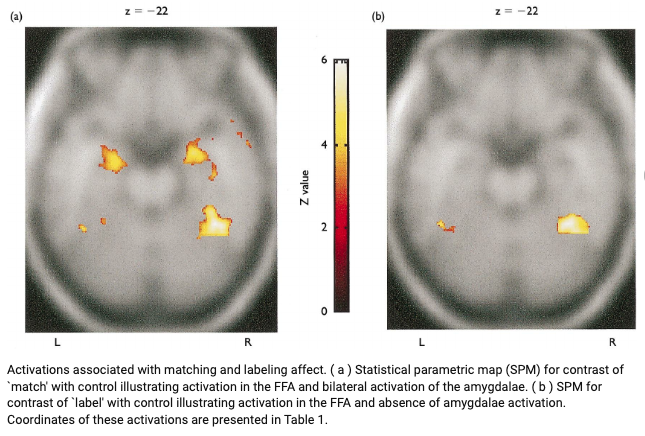
What Happened in the Brain: Amygdala Activation vs. Prefrontal Cortex Activation During Emotion Labeling
When participants visually matched the faces, their amygdala (the brain's threat detection center) lit up strongly on both sides.
When participants labeled the emotion in words, two things shifted. The amygdala response decreased, and activity increased in the right ventral prefrontal cortex, a region associated with reasoning, evaluation, and cognitive control.
The two regions appeared to work in opposition. The prefrontal cortex acted like a brake on the amygdala. Naming the emotion engaged a higher cortical system that quieted the more reactive limbic system below it.
The authors framed this as a neural basis for modulating emotional experience through interpretation and labeling.
A Follow-Up Study: Hariri et al. (2003): Neocortical Modulation of the Amygdala Response to Fearful Stimuli
A single study, even an elegant one, can be a starting point. What makes this finding meaningful is that it held up.
In 2003, Hariri and colleagues replicated and extended the work using threatening images from the International Affective Picture System, scenes rather than faces. The same pattern emerged. Perceptual processing of the threatening images activated the amygdala. Linguistic evaluation of the same images attenuated that amygdala response and increased activity in the right ventral prefrontal cortex.
The effect was not specific to faces or to one experimental setup. It reflects a broader principle in how the brain organizes emotional experience.
The Emotional Face Matching Task developed in the original study has since been used in hundreds of follow-up studies on anxiety, depression, emotional regulation, and pharmacology, and it is now considered one of the most reproducible paradigms in affective neuroscience.
How Naming Emotions Regulates Anxiety in Daily Life
An emotion that stays vague tends to stay reactive. When anxiety runs in the background without language attached to it, the limbic system holds the wheel. It’s subconsciously underlying every thought you have and every move you make. In coaching terms, this can be considered “open loops” that you haven’t closed (and that take up energetic and emotional bandwidth) or simply “tabs that haven’t closed.”
The moment you define what you are feeling, you bring a different system online, close the loop, and close the tab.
Labeling does not suppress the emotion. It organizes it.
In practice, that looks like moving from "I feel off" to something more specific:
I feel anxious about uncertainty. I feel frustrated and a little out of control. I feel nervous about being judged.
You are not analyzing yourself. You are giving the experience a shape, which is what allows the prefrontal cortex to engage and the amygdala to settle.
Important: The Difference Between Labeling an Emotion and Ruminating on It
There is an important distinction here. Naming an emotion is not the same as analyzing it, replaying it, or building a case around it.
Labeling is brief. It identifies what is present and lets the prefrontal cortex come online. Rumination is repetitive. It loops through the same content, often layering judgment and worst-case thinking on top, which keeps the threat system activated rather than quieting it.
A useful rule is one clear sentence. Name the emotion, name what it is connected to, and stop there.
Labeling: I feel anxious, and it is about this conversation I have to have tomorrow.
Ruminating: What if I say the wrong thing, what if they react badly, I should rehearse every possible response, I always mess these up, this is going to ruin everything.
Labeling: I feel sad, and it is about the way that interaction ended.
Ruminating: I keep replaying what they said, I should have responded differently, what does it mean about our relationship, did I do something wrong, are they upset with me, I cannot stop thinking about it.
Labeling: I feel overwhelmed, and it is about how much is on my plate this week.
Ruminating: I will never get through all of it, I am behind on everything, why did I take this on, other people manage this fine, something is wrong with me, I should have planned better, maybe I’m not smart or talented enough, maybe I should have spent my time more productively.
The first version in each pair is the regulation work. The second keeps the threat system activated and the body in a stress response.
If you notice you are spiraling, the same tool still applies. Name the spiral. "I am ruminating right now." That label itself engages the prefrontal cortex and creates the small bit of distance that lets you step out of the loop.
A Small Shift With a Measurable Effect
Naming an emotion does not erase it. It changes your relationship to it. You move from being inside the feeling to standing slightly beside it, and that small distance is often enough for the brain to begin regulating itself.
This is not only a mindset practice. It is a measurable change in how the brain responds to threat.
References
Hariri, A. R., Bookheimer, S. Y., & Mazziotta, J. C. (2000). Modulating emotional responses: effects of a neocortical network on the limbic system. NeuroReport, 11(1), 43–48.
Hariri, A. R., Mattay, V. S., Tessitore, A., Fera, F., & Weinberger, D. R. (2003). Neocortical modulation of the amygdala response to fearful stimuli. Biological Psychiatry, 53(6), 494–501.