
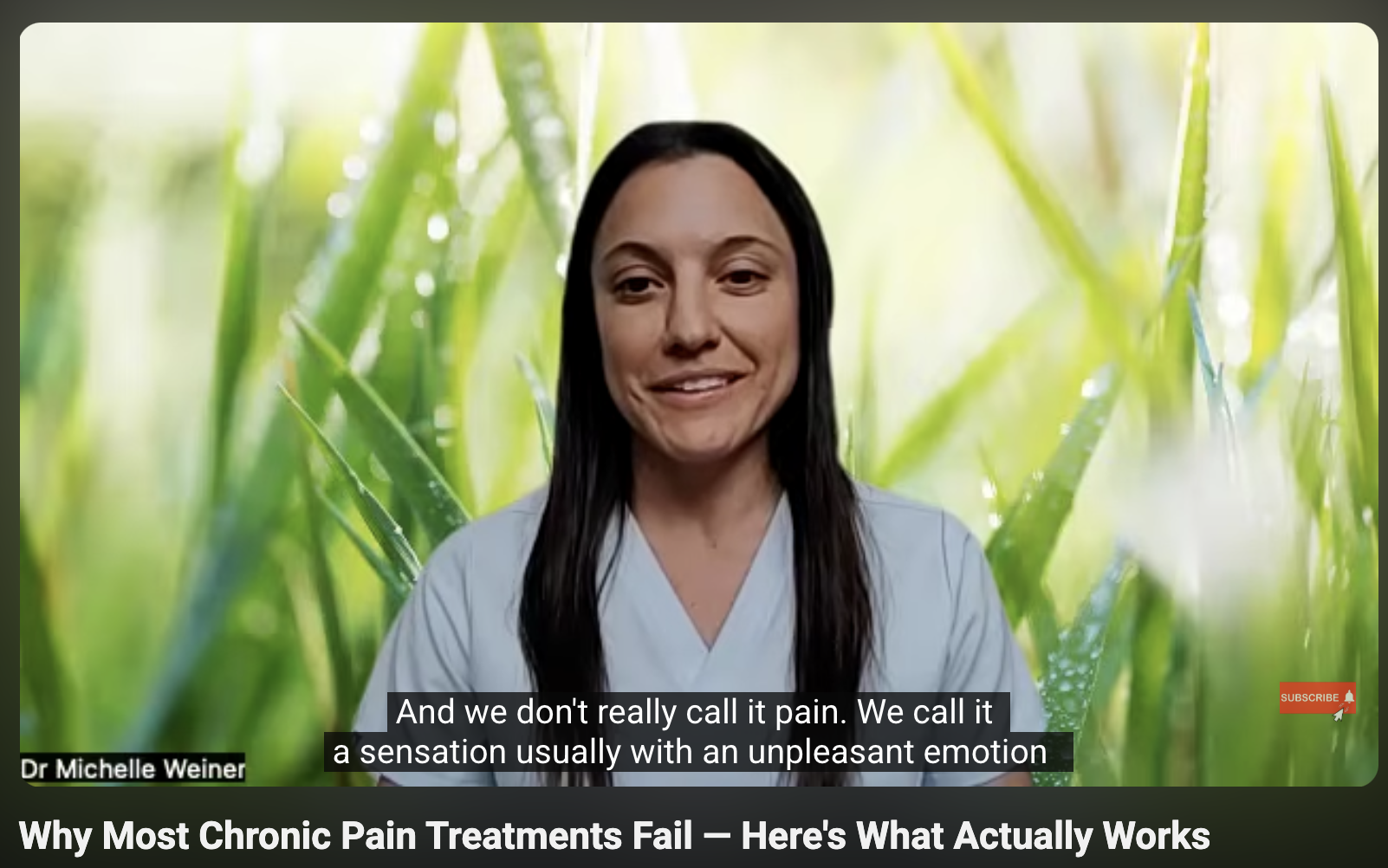
I recently had the opportunity to join Catherine Goldberg on the Senior Savvy Cannabis podcast for a conversation about chronic pain, how/why it is so often misunderstood, and why treatment needs to go beyond a purely structural lens.
We talked about the limitations of the conventional medical model, the role of the nervous system in chronic pain, where Pain Reprocessing Therapy fits in, and how I think about cannabis as one tool within a broader, more individualized treatment plan.
I’m grateful to Catherine for the opportunity to have this conversation. Below is a recap of some of what we covered.
You can listen to the full episode on Spotify or watch it on YouTube.
Why So Many Chronic Pain Treatments Fall Short
One of the biggest problems in chronic pain care is that many patients are still being treated as if pain is only a structural or mechanical issue.
Something hurts, so the reflex is to numb it, inject it, medicate it, or image it again. Sometimes those tools absolutely have a role. But when pain becomes chronic, that approach is often too narrow.
In many cases, the issue is not that the patient is “failing” treatment. It is that the treatment approach is too narrow.
Chronic pain is not only tissue damage. It is a biopsychosocial experience, meaning it involves the body, the brain, the nervous system, and the lived experience of the person in pain. Biology and anatomy are relevant, and so are the person’s stress, sleep, trauma, fear, coping patterns, and the way the nervous system has learned to interpret sensation.
That does not make the pain any less real. It makes the picture more complete.
Pain Is Not Always a Sign of Ongoing Damage
This is one of the most important shifts in how I think about pain.
Pain can happen with tissue damage, but it can also persist without ongoing damage. In many chronic pain conditions, the nervous system becomes sensitized. It becomes more reactive, more protective, and more likely to interpret sensation as a threat.
You can think of it as a fire alarm system that keeps going off even when the fire is gone.
If someone is sleeping poorly, under chronic stress, carrying unresolved trauma, or constantly afraid of what each flare means, the nervous system may stay stuck in protection mode. That state can amplify pain and make recovery harder.
This is why the question cannot only be, “What structure is causing this?”
Sometimes the better question is, “What is keeping this whole-body system in a state of danger?”
That shift changes treatment.
Chronic Pain and Mental Health Are Closely Linked
Pain and mental health are not separate conversations.
PTSD, anxiety, depression, chronic stress, and trauma can all shape how pain is processed and maintained. That does not mean pain is “just psychological.” It means the brain and nervous system are involved, and if we ignore that, we miss part of what is driving the problem.
This is also why I am interested in tools like cannabis-assisted coaching and ketamine-assisted therapy in the right cases. These approaches may help patients shift rigid patterns, connect with the body differently, and access more flexibility, awareness, or safety.
Again, the point is not to escape symptoms. It is to better understand and treat what may be contributing to them.
Why I Think Pain Reprocessing Therapy Deserves More Attention
One approach I find especially valuable is Pain Reprocessing Therapy, or PRT.
At its core, PRT helps people change the way they relate to pain. It does not deny symptoms or pretend the pain is not real. It does help the brain and nervous system stop interpreting every sensation as dangerous.
That often includes learning how to track sensations with less fear, regulate the nervous system, build body awareness, and interrupt the loop of pain, fear, tension, and more pain.
For many people, fear is a major amplifier.
They fear what the pain means. They fear movement. They fear making it worse. They fear that nothing is helping. And once fear starts driving the process, the nervous system often gets louder.
PRT is one way to interrupt that cycle.
In my view, this kind of work should be considered much earlier for the right patient, not only after years of medications, procedures, and frustration.
Mindfulness and Somatic Work Are Not Optional “Extras”
A lot of pain care stays overly cognitive. People analyze symptoms, read reports, search for the right diagnosis, and brace for the next flare.
At the same time, many are deeply disconnected from their bodies.
This is where mindfulness and somatic work can be very useful. This work helps people notice sensation without immediately going into fear. It helps restore some sense of safety in the body.
That is important, because healing does not come through symptom suppression (in fact, suppression often makes it worse). Healing requires changing the relationship to the symptom.
Where Cannabis Fits into Chronic Pain Care
Cannabis can be a helpful tool in chronic pain care, but I do not view it as a cure-all.
It is one tool in a larger treatment plan.
For the right patient, cannabis may help reduce pain, improve sleep, lower stress, and create enough relief that they can engage more meaningfully in therapy, coaching, movement, or nervous system work. Sometimes it creates enough space for a person to feel less stuck.
But the medicine alone is rarely the whole answer.
The medicine matters, but the relationship and container matter most.
What I mean by that is simple: cannabis tends to work best when it is part of a thoughtful, individualized plan with preparation, education, follow-up, and support. Without that, people are often left guessing about product type, dose, timing, and what to do when the experience does not go as expected.
Why Older Adults Are Often Good Candidates for Medical Cannabis
One population I especially like working with is older adults.
Many seniors are dealing with chronic pain, poor sleep, multiple diagnoses, and multiple prescriptions. In the right context, cannabis can sometimes help address several issues at once while reducing reliance on medications that may carry more risk.
But this only works when dosing is handled carefully.
One of the biggest mistakes I see is giving cannabis-naive patients doses that are far too high. A 25 mg THC product for an older adult with no tolerance can go very badly. That kind of experience can turn someone off from a treatment that may actually have helped if it had been introduced properly.
This is why I am so careful about the “start low and go slow” approach. Cannabis is highly individualized. A dose that feels mild to one person may feel overwhelming to another.
Cannabis Research Still Has Real Limitations
Patients understandably want evidence, and I do too. But cannabis research still has significant limitations.
It is difficult to blind cannabis studies well because people often know whether they received an active product (the “knowcebo effect”). Much of the older research used lower-potency cannabis than what patients are actually using now. And perhaps most importantly, people do not respond to cannabis in the same way.
The endocannabinoid system is highly individualized.
That is one reason broad claims about cannabis can be misleading. It is not a one-size-fits-all intervention, and it should not be presented that way.
Why I Take an Integrative Approach to Chronic Pain
In my experience, chronic pain care works best when it is integrative, individualized, and honest about complexity.
That may include pain reprocessing therapy, mindfulness, somatic work, physical therapy, coaching, medical cannabis, ketamine-assisted therapy, or more traditional pain management tools when appropriate.
The larger goal is not simply to mute symptoms.
The goal is to understand what is happening in the nervous system, reduce unnecessary fear, improve function, and help patients build a different relationship with their body… and that helps reduce symptoms.
Learn More
If you have been dismissed, overmedicated, or made to feel like your only options are to endure the pain or numb it, there may be more room for healing than you have been led to believe.
Read more about our approach to Pain Reprocessing Therapy, Ketamine-Assisted Psychotherapy, and medical cannabis.